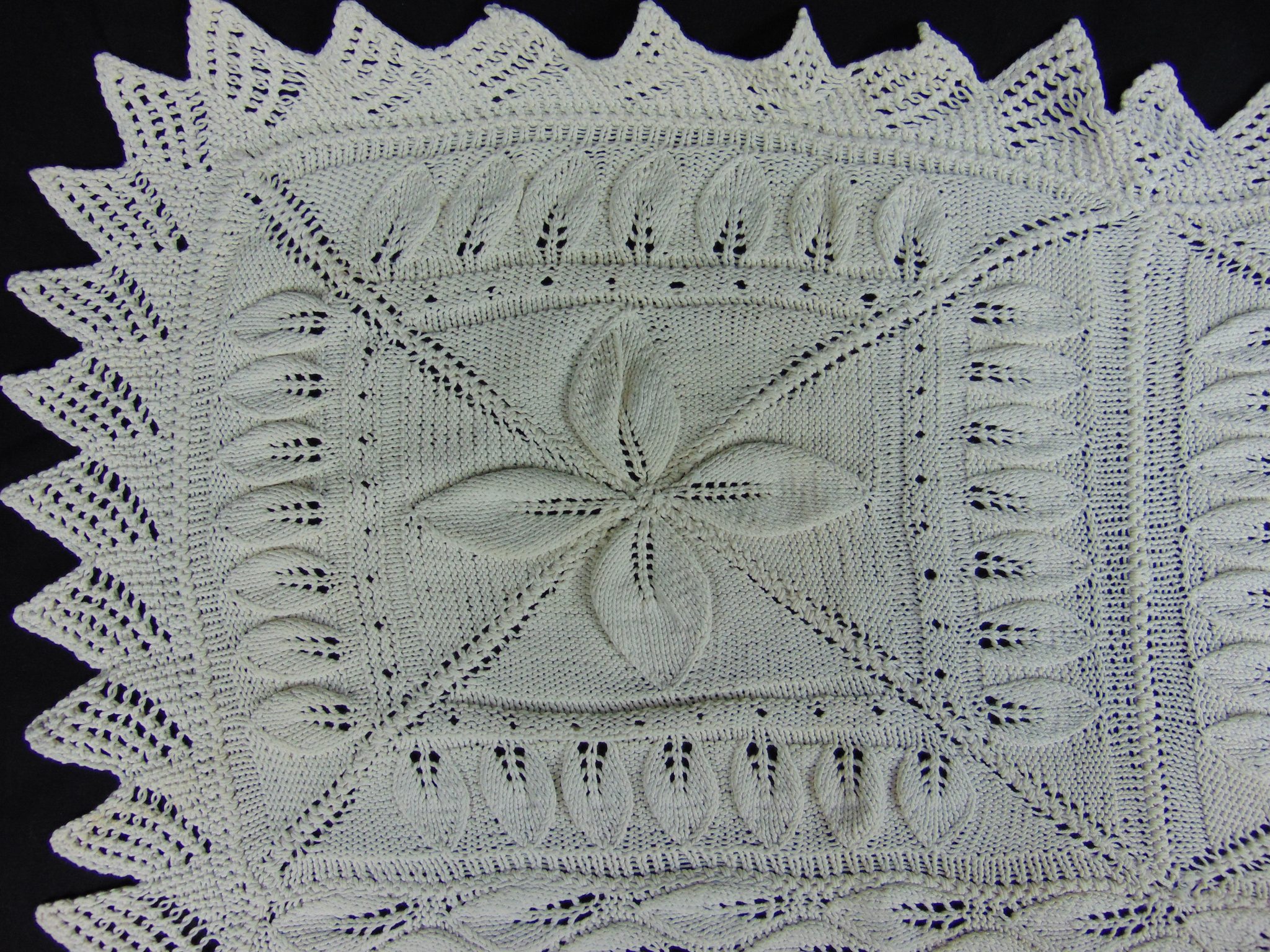
Recreating the pattern of a knit counterpane bureau scarf from the collection of the Huron County Museum and Historic Gaol is a fascinating trip through vintage knitting patterns and traditions.
Counterpanes – white bed coverlets or bedspreads – were quite popular in the mid-1800s and into the 1900s and were traditionally made from white or cream-coloured cotton yarn that was so readily available at that time. The coverlets were also sometimes called quilts and were pieced together, comprised of square or circular motifs for example, in a similar way as a quilt top.
The inspiration. This photo shows the upper-left corner of the original heirloom knit counterpane bureau scarf in the collection of the Huron County Museum and Historic Gaol. (Photo courtesy of the Huron County Museum and Historic Gaol)
The knitted 1890 counterpane bureau scarf in the museum collection consists of three components: 3 squares made up of 4 triangles each, a leaf panel below the assembled squares, and a pointed, saw-tooth edging. The four triangles are knit separately then crocheted together. The squares each measure 12″ by 12″; the leaf panel measures 8″ by 48″.
There are a wide variety of research materials out there for vintage pattern enthusiasts: books, stitch encyclopedias, websites and blogs, magazines, as well as other stitchers, writers and researchers who are also working on pattern recreations.
Recreated counterpane leaf pattern in the form of a pillow.
In all of our research, we were unable to find an exact pattern for the museum counterpane bureau scarf. But, what we did find was a leaf pattern in one book, a triangle counterpane pattern in another, and then a similar edging in another resource. Essentially, we are attempting to reverse engineer the piece, writing the pattern after examining the item, counting the stitches, looking at the placement of the increases and decreases and so on.
After some trial and error, trying various needles sizes and yarn types and weights, we settled on recreating the pattern in locally sourced worsted-weight wool from Steele Wool Farm.
Counterpane Pillow – A Pattern to Knit
The pattern is available for those of you interested in trying it out.
Here’s a link to the free version of Counterpane Pillow pattern readily accessible as a blog post: Counterpane Pillow Pattern.
If you’d like to purchase a downloadable PDF version, please go to our Shop Page. Please note all sales from the Counterpane Pillow pattern are donated to the Huron County Museum in Goderich, Ontario, to go to the care of their textile collection.
A counterpane pincushion, inspired by an heirloom counterpane baby blanket in the collection of the Huron County Museum & Historic Gaol located in Goderich, Ontario.
Do you love stitching from old patterns?
I certainly do. I also enjoy trying to recreate a pattern based upon a stitched item.
This pincushion is inspired by a white cotton counterpane baby blanket in the collection of the Huron County Museum and Historic Gaol in Goderich, Ontario.
White cotton counterpanes (or coverlets) were common in the nineteenth century, as was “white knitting,” due to the preference at the time for white bed coverings and because of the ready availability of cotton yarn.
Counterpanes are made up of smaller units (squares or octagons, for example) that are worked separately and then joined together to create an overall design or effect. They were traditionally knitted or crocheted in white or cream-colored cotton yarn. Patterns were numerous and could be quite intricate.
The heirloom original, the inspiration for the pincushion. A portion of the folded counterpane baby blanket can been seen in the photo. (Photo courtesy of the Huron County Museum & Historic Gaol)
Knitted about 1812, the white cotton counterpane in the museum’s collection is of a simple and lovely design. The blanket was constructed of 3-inch (7.6-cm) square units joined together, forming an overall On Point pattern: the eyelet spaces create the optical illusion of nested diamonds. Each unit is worked from one corner to the opposite corner, with garter stitch in the lower half of the unit, a row of eyelets through the middle, and alternating stockinette-stitch and reverse-stockinette-stitch ribbing above. The garter-stitch rows feature a yarn-over increase at the beginning of each row.
The front of the pincushion features the same overall layout as the museum’s crib blanket. On the reverse of the pincushion, the units are placed so that the yarn-over edges connect to highlight the lovely lace-like effect created when the yarn-overs are joined by a simple whip stitch. The knitted edging is a recreation of the original edging on the crib counterpane.
PINCUSHION INSTRUCTIONS
Pincushion Units
Make 8
CO 2 sts.
Next Row: Yo, k to end—1 st inc’d.
Rep last row 33 more times—36 sts.
P 1 row.
Eyelet Row (RS): K1, [yo, k2tog] 17 times, k1.
P 1 row.
K 1 row.
*Next Row (WS): K1, k2tog, k to end—1 st dec’d.
Next Row (RS): P1, p2tog, p to end—1 st dec’d.
Rep last 2 rows once more—2 sts dec’d.
Next Row (WS): P1, p2tog, p to end—1 st dec’d.
Next Row (RS): K1, k2tog, k to end—1 st dec’d.
Rep last 2 rows once more—2 sts dec’d.
Rep from * 3 more times—4 sts rem.
Next Row (WS): K1, k2tog, k to end—3 sts rem.
Next Row (RS): P1, p2tog, p to end—2 sts rem.
Next Row: K2tog—1 st rem. Fasten off.
EDGING
CO 13 sts
Row 1: K2, [yo, k2tog] 3 times, k1 [yo, k2] 2 times—15 sts.
Row 2: K8, [yo, k2tog] 3 times, k1.
Row 3: K2, [yo, k2tog] 3 times, k7.
Row 4: K8, [yo, k2tog] 3 times, k1.
Row 5: K2, [yo, k2tog] 3 times, k3 [yo, k2] 2 times—17 sts.
Row 6: K10, [yo, k2tog] 3 times, k1.
Row 7: K2, [yo, k2tog] 3 times, k9.
Row 8: BO 4 sts, k6 (including st rem on right needle after BO), [yo, k2tog] 3 times, k1—13 sts rem.
Rep Rows 1–8 until piece measures 25 inches (63.5 cm), ending with Row 8. BO all sts.
FINISHING
Wash all pieces and dry flat to block. For the front of the pin cushion, arrange four units so the ribbing sections align, and sew together using whip stitch. For the back, arrange four units so the yarn-over sides align, and sew together using whip stitch. Weave in ends. Sew front and back pieces together, leaving one side open for stuffing. Fold felted batting in half, fill to desired thickness with fiberfill stuffing, put into pincushion, and sew last side closed. Sew on edging using whip stitch. Sew ends of edging together.
ABBREVIATIONS
BO bind off
CO cast on
DEC decrease
K knit
K2tog knit two stitches together
P purl
P2tog purl two stitches together
RS right side
WS wrong side
YO yarn over
FINISHED MEASUREMENTS
6 inches (15.2 cm) square, excluding edging.
YARN
The sample was stitched with DMC Baroque, 100% cotton thread, bedspread weight, 416 yards (380.4 m)/75 gram (2.6 oz) skein, 3 skeins of White.
NEEDLES
Needles size 0 (2 mm) or size needed to obtain gauge.
GAUGE
36 sts and 72 rows = 4 inches (10.2 cm) in garter st; one unit = 3 inches (7.6 cm) square.
NOTIONS
Tapestry needle
Warm and Natural Felted batting, 6 x 12 inches (15.2 x 30.5 cm)
Warm & Natural Needled Cotton, the Warm Company
Small amount of fiberfill stuffing.
You must be logged in to post a comment.