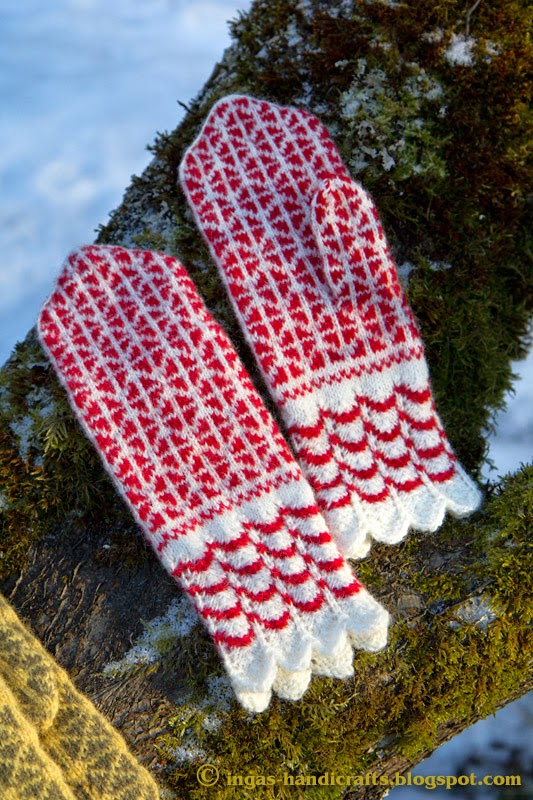
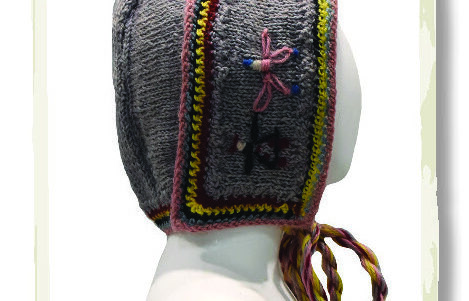
Well, it’s a very cold and snowy March here which brings to mind issues of warmth. Did you know there’s a matching knitted hat pattern to go along with the ‘Wheelers Mitts’ pattern?
You bet! Have a read and cast on! Create your own fun variation. Enjoy knitting up some textile history.
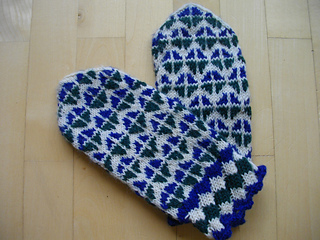
Wheeler Hat and MittsWheeler MittsWheeler Hat 1Wheeler Hat 2
Wheeler Hat Knitting Pattern
SIZE One size to fit adult. YARN 1 skein (113 g/4 oz) worsted weight wool in light colour (MC); 1 skein in medium(A); 1 skein in dark (B). NEEDLES: Sizes U.S. 6 (4 mm) and U.S. 7 (4.5 mm) circular knitting needles 16″ [40.5 cm] long. Set of four size U.S. 7 (4.5 mm) double-pointed knitting needles or size needed to obtain gauge. Stitch marker. GAUGE: 20 sts and 26 rows = 4″ [10 cm] in stocking st with larger needles. NOTE: the background colour becomes the motif colour in the next band in the Wheeler Chart.
Please see chart as in the Wheelers Wristers & Mitts pattern for reference.
Wheeler Chart
INSTRUCTIONS With MC and smaller circular needle, CO 96 sts. Join in rnd and PM on first st. 1st rnd: *K2. P2. Rep from * around. Rep this rnd of (K2. P2) ribbing for 1½” [4 cm]. Next rnd: *M1. K12. Rep from * around. 104 sts. Change to larger circular needle and proceed as follows: 1st rnd: Knit with MC 2nd to 9th rnds: Knit rows 1 to 8 of S&P chart, noting 8-st repeat will be worked 13 times. 10th to 17th rnds: Knit rows 1 to 8 of Wheeler chart, noting 8-st repeat will be worked 13 times. 18th to 25th rnds: Knit rows 1 to 8 of S&P chart, noting 8-st repeat will be worked 13 times. 26th to 48th rnds: Knit with MC Crown shaping: 1st rnd: *K11. K2tog. Rep from * around. 96 sts. 2nd, 4th, 6th and 8th rnds: Knit. 3rd rnd: *K10. K2tog. Rep from * around. 88 sts. Change to DPNs 5th rnd: *K9. K2tog. Rep from * around. 80 sts. 7th rnd: *K8. K2tog. Rep from * around. 72 sts. 9th rnd: *K7. K2tog. Rep from *around. 64 sts. 10th rnd: *K6. K2tog. Rep from * around. 56 sts. 11th rnd: *K5. K2tog. Rep from * around. 48 sts. 12th rnd: *K2. K2tog. Rep from * around. 32 sts. 13th rnd: *K1. K2tog. Rep from * around. 24 sts. Break yarn, leaving a long end. Thread end through rem sts and draw up tightly. Fasten securely. Pompom (optional) Wind MC, A, and B around 4 fingers 25 times. Tie tightly in the middle and leave a long end for attaching to hat. Cut loops at both ends and trim to smooth round shape. Sew securely to top of Hat. Abbreviations CO cast on DPNs double-pointed needles K2tog knit 2 stitches together M1 make 1 (note: choose favourite method) MC main colour P purl PM place marker REM remaining REP repeat RND round S&P salt and pepper ST/S stitch/stitches
Wheeler Mitts Knitting Kits
Would you like to try your hand at knitting the Wheeler Mitts? The Huron County Museum has a number of Wheeler Mitts knitting kits available for purchase. All proceeds from the kits go to the care of the wonderful textile collection at the museum.
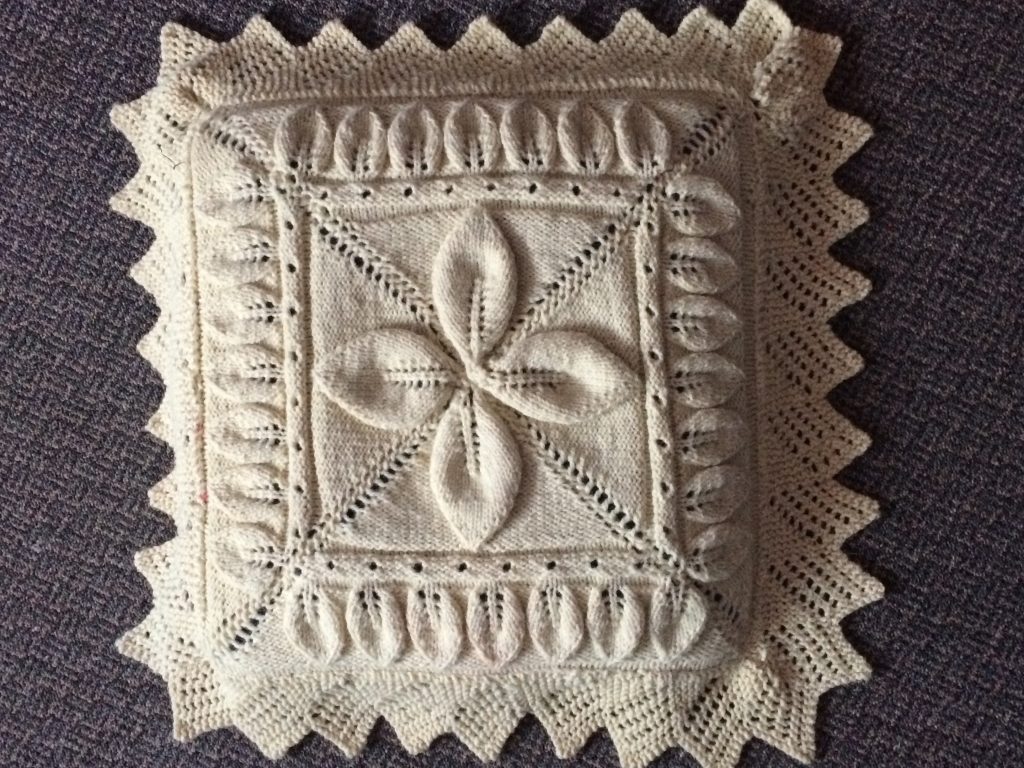
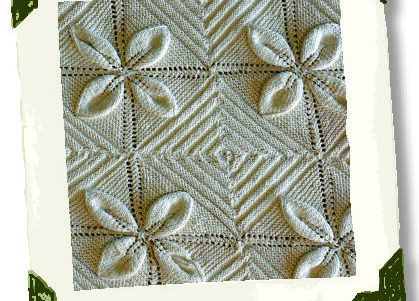
Re-created counterpane leaf pattern in the form of a pillow.
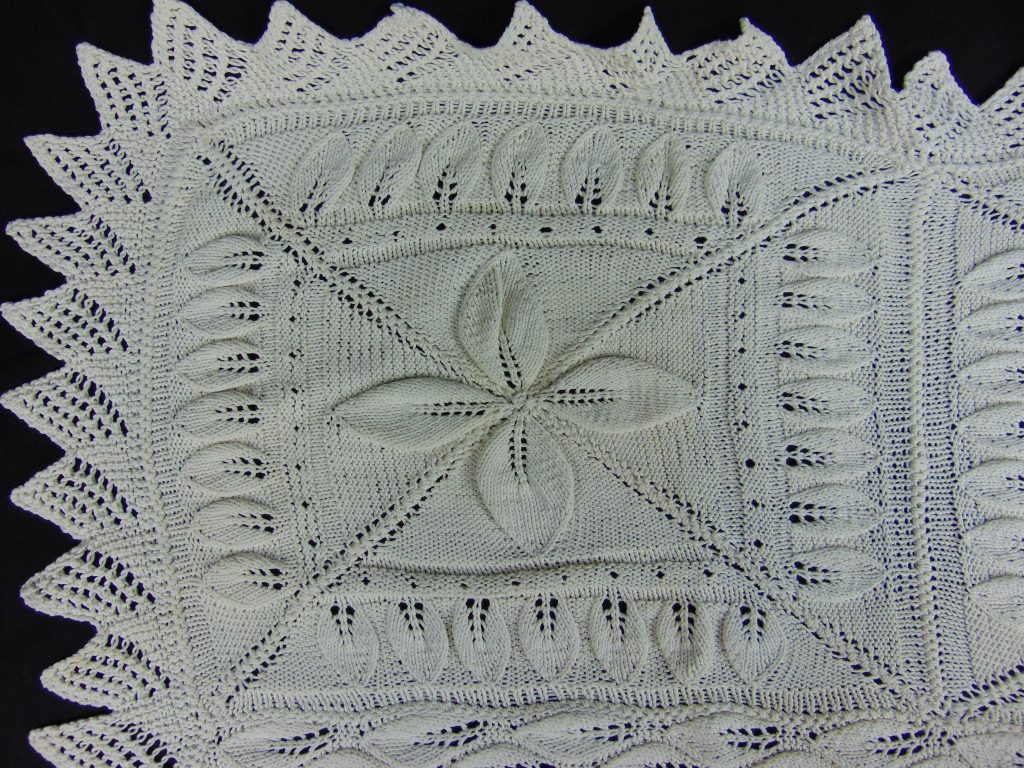
This pillow pattern is inspired by a white cotton counterpane bureau scarf in the collection of the Huron County Museum and Historic Gaol located in Goderich, Ontario.
Please note: If you’d like to purchase a printed version of the pattern, please visit or contact the Huron County Museum at (519) 524-2686.
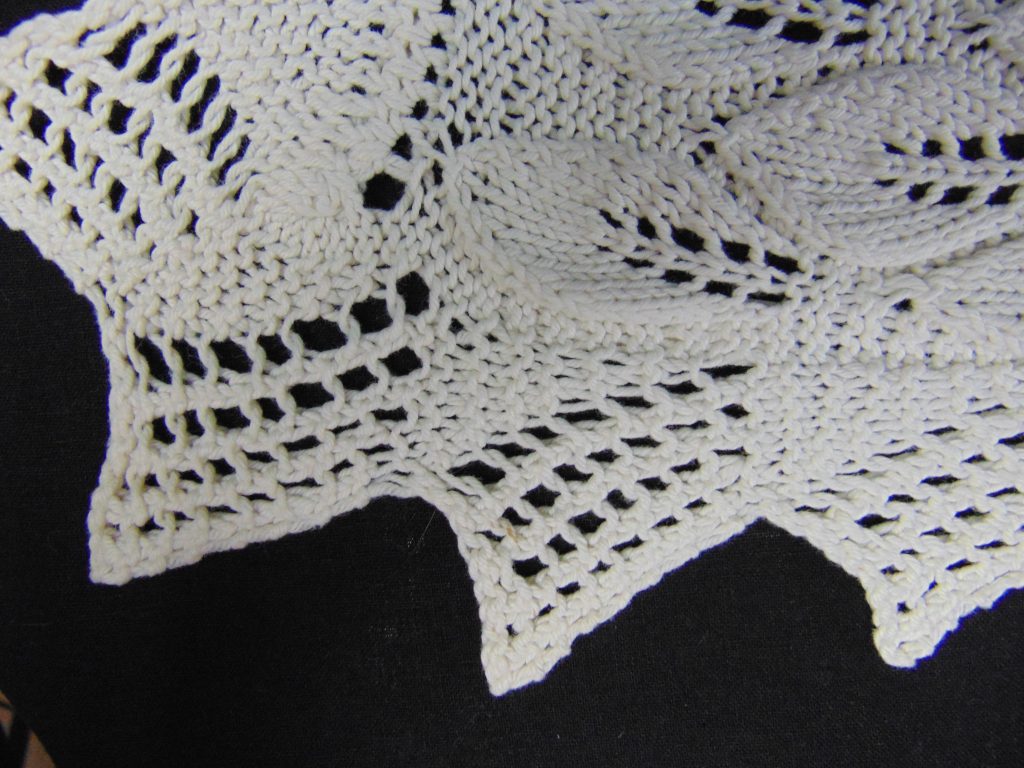
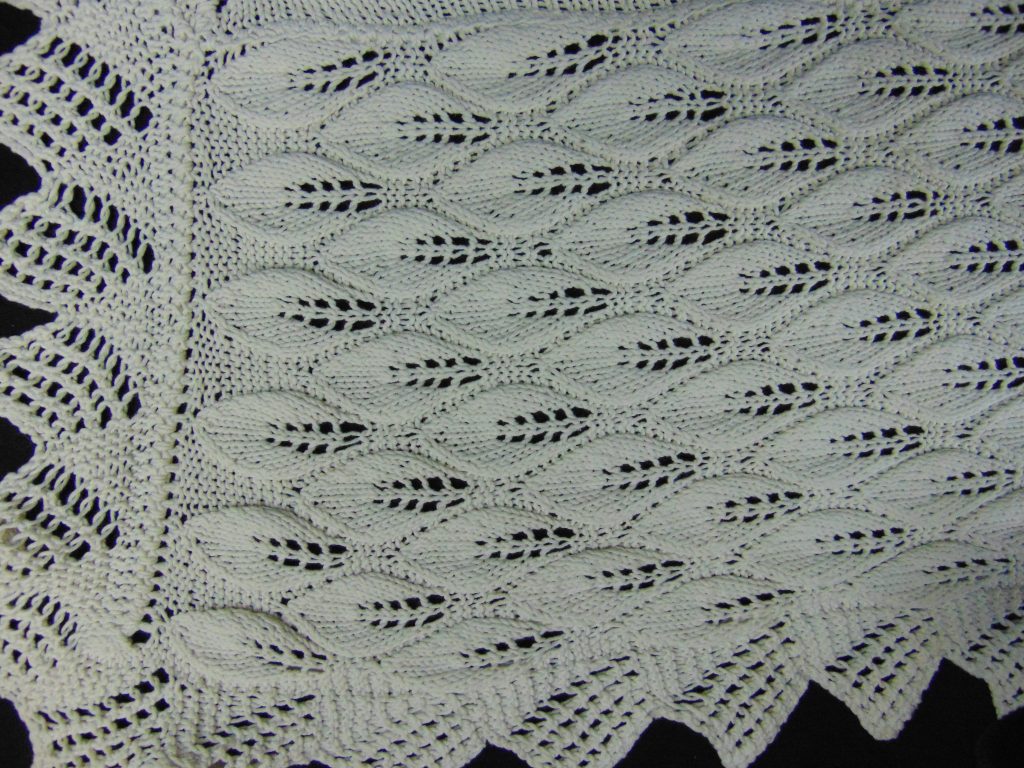
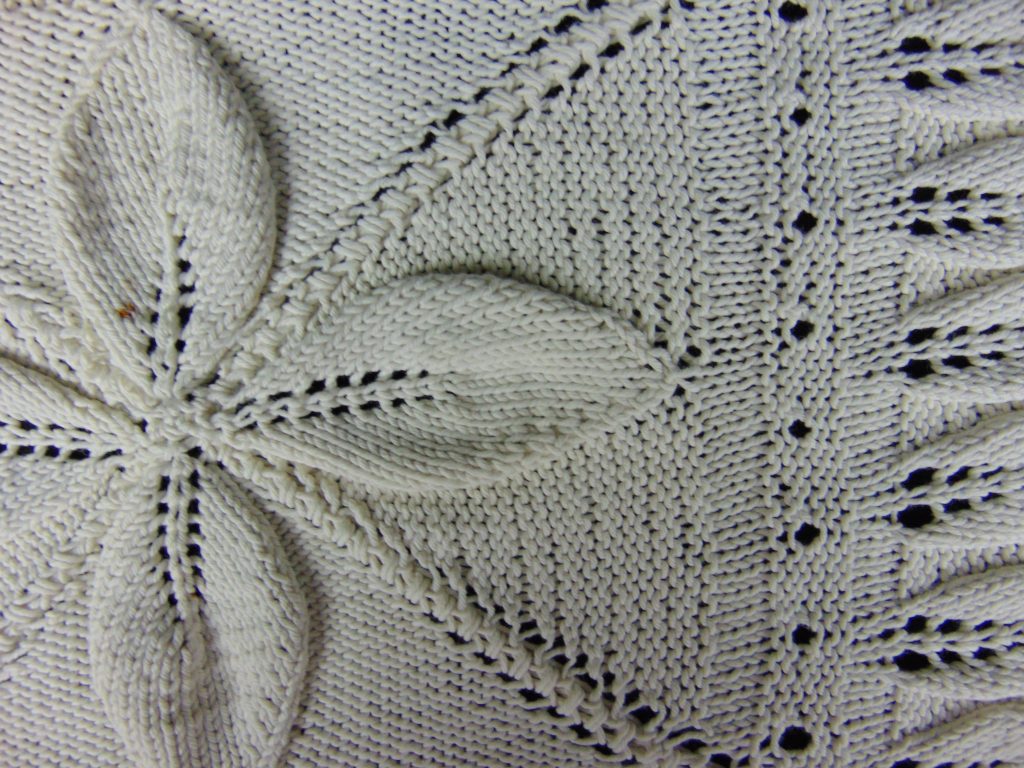
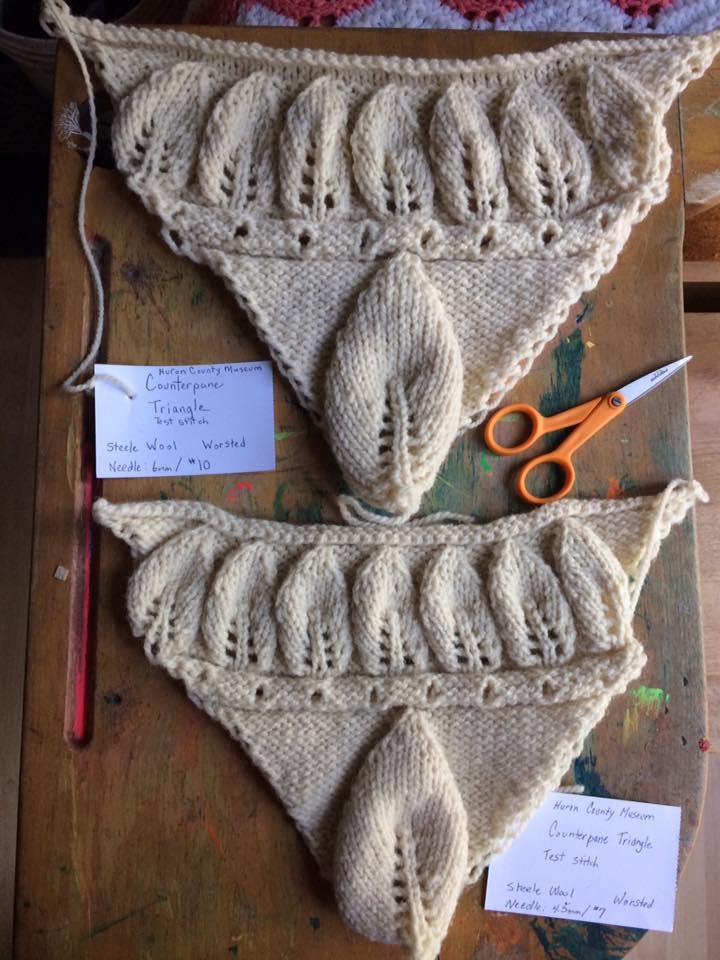
A traditional counterpane would have been made in white cotton and constructed from a number of smaller units (squares or octagons, for example) that are worked separately and then joined together to create an overall design or effect. The scarf in the museum’s collection is made up of three leaf square units above a panel of leaf lace and then bordered by the pointed lace edging. Cotton rug warp was used to knit the piece, a common practice at the time. Below are a number of images of the original bureau scarf as well as the reproduction.
The original
Counterpane Pillow – A Pattern to KnitThe inspiration. This photo shows the upper-left corner of the original heirloom knit counterpane bureau scarf in the collection of the Huron County Museum and Historic Gaol. (Photo courtesy of the Huron County Museum and Historic Gaol)
The front of our counterpane pillow features the 4-part counterpane square as does the back of the pillow. The pointed lace edging is a recreation of the original edging on the bureau scarf.
Pattern
FINISHED SIZE This pattern consists of triangles joined together to form a square. Each triangle measures 9” from leaf point to cast-off straight edge. Assembled square measures 18” square, with pointed lace edging, 24” square.
YARN Worsted weight yarn. The sample in the photo was knit with worsted weight yarn from Steele Wool Farm; approximately 3 hanks needed to complete pillow front. NEEDLES Size US 7 (4.5 mm) or size needed to obtain gauge
GAUGE 4 to 5 stitches per inch on a size 7 (4.5mm) knitting needle (gauge is approximate).
NOTIONS Tapestry needle Extra yarn for sewing together 18” pillow form
POINTED LACE EDGING CO 9 sts 1st row: K1, (YO, K2tog) three times, YO, K2 2nd and every alternate row: Knit to end 3rd row: K2, (YO, K2tog) three times, YO, K2 5th row: K3, (YO, K2tog) three times, YO, K2 7th row: K4, (YO, K2tog) three times, YO, K2 9th row: K5, (YO, K2tog) three times, YO, K2 11th row: K6, (YO, K2tog) three times, YO, K2 13th row: K7, (YO, K2tog) three times, YO, K2 15th row: Knit to end 16th row: Bind off 7 sts, K8 Rows 1-16 form pattern. Repeat for desired length.
FINISHING Wash all pieces and lay flat to block, pinning to correct measurements.
CONSTRUCTION For the front and back of the pillow, arrange four triangle units wrong-side up so the leaf corners align at the centre and single crochet triangle units together. Mattress stitch can be used instead of single crochet, but arrange triangles right-side up for this method. Using a whip stitch, sew front and back assembled squares together, leaving one side open for the pillow form to slide in. Slide pillow into place. Sew last side closed or leave open, depending on your personal choice. Attach pointed lace edging around the perimeter of the pillow using mattress stitch. Weave in ends.
ABBREVIATIONS BO bind off CO cast on DEC decrease K knit K2tog knit two stitches together P purl P2tog purl two stitches together RS right side WS wrong side YO yarn over
About the designer
Sharlene Young-Bolen is a Blyth-based knitter with a love & appreciation for all things vintage & handmade. For pattern support or questions, please contact sbolen@stitchrevivalstudio.ca. Irene Kellins is the past owner of Stitches with a Twist, a yarn and sewing shop in the village of Blyth, Ontario. She has had years of experience knitting, crocheting, and sewing, and she especially enjoys instructing others in the needle arts. Irene works out of her home studio in Blyth, Ontario and consulted on this pattern project, helping Sharlene decipher the original piece.
Was there a family tie to either Estonia or the British Isles? The answer would help to identify the glove pattern perhaps. When an instagram post by Best Dishes, a Goderich business owned by Sarah Anderson, appeared in my feed one day identifying the wristers pattern as based on a family heirloom, chance had dropped the perfect opportunity. It was time to connect. A couple messages back and forth and the story unfolded…
History of the Wheeler Family
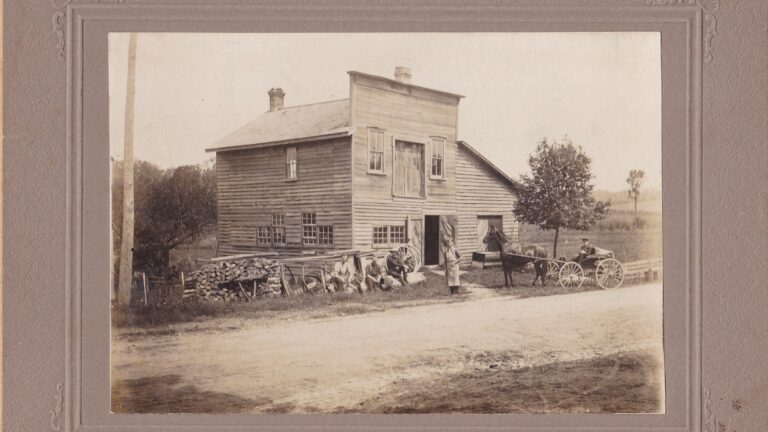
Herb Wheeler's Carpentry Shop in Belgrave, Ontario, Herb standing in front (Photo courtesy of Richard Anderson).
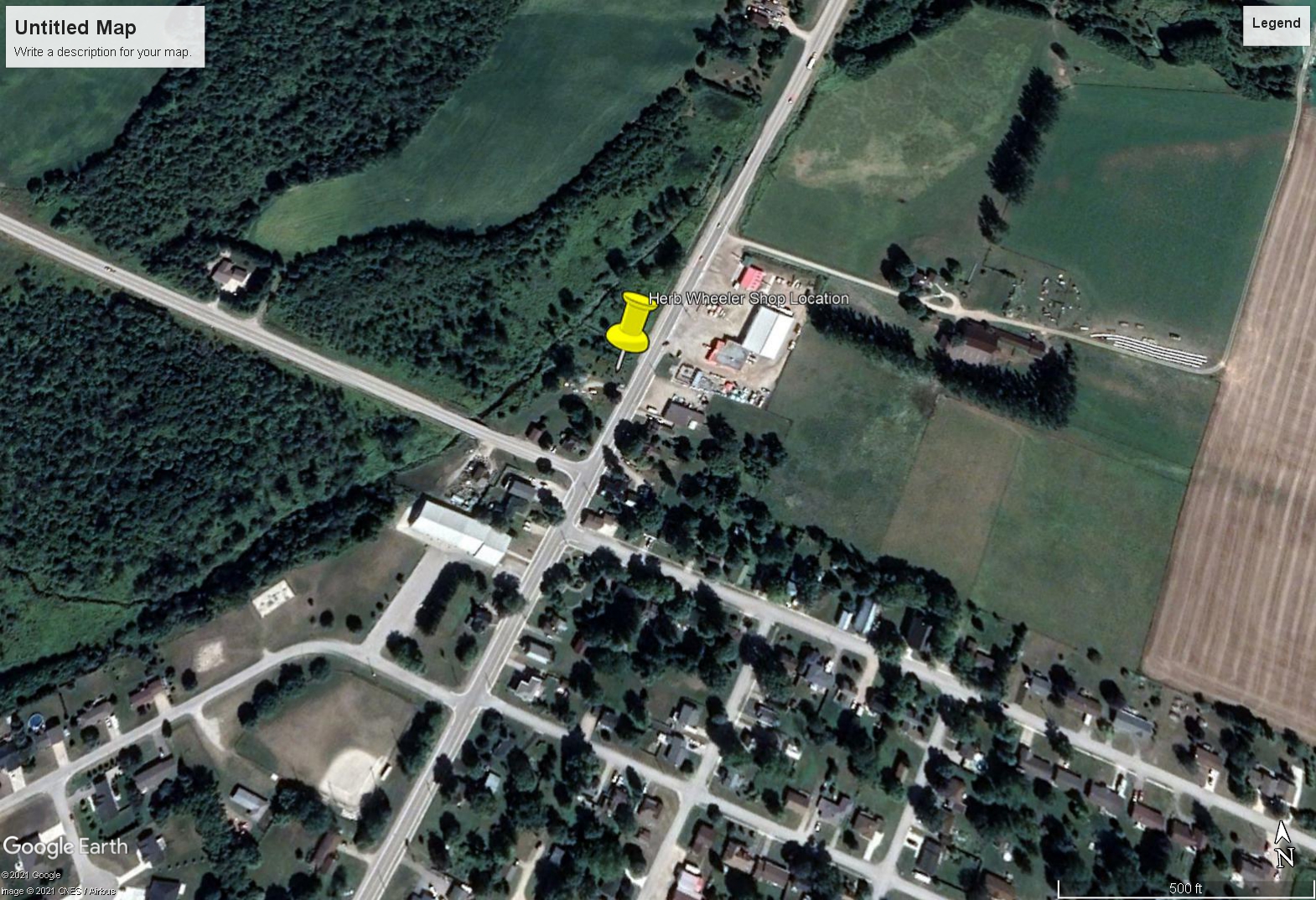
The yellow pin marks the location of Herb Wheeler's shop. The intersection in the center is downtown Belgrave and the road going off the top is County Rd 4 (London Road) heading toward Wingham.
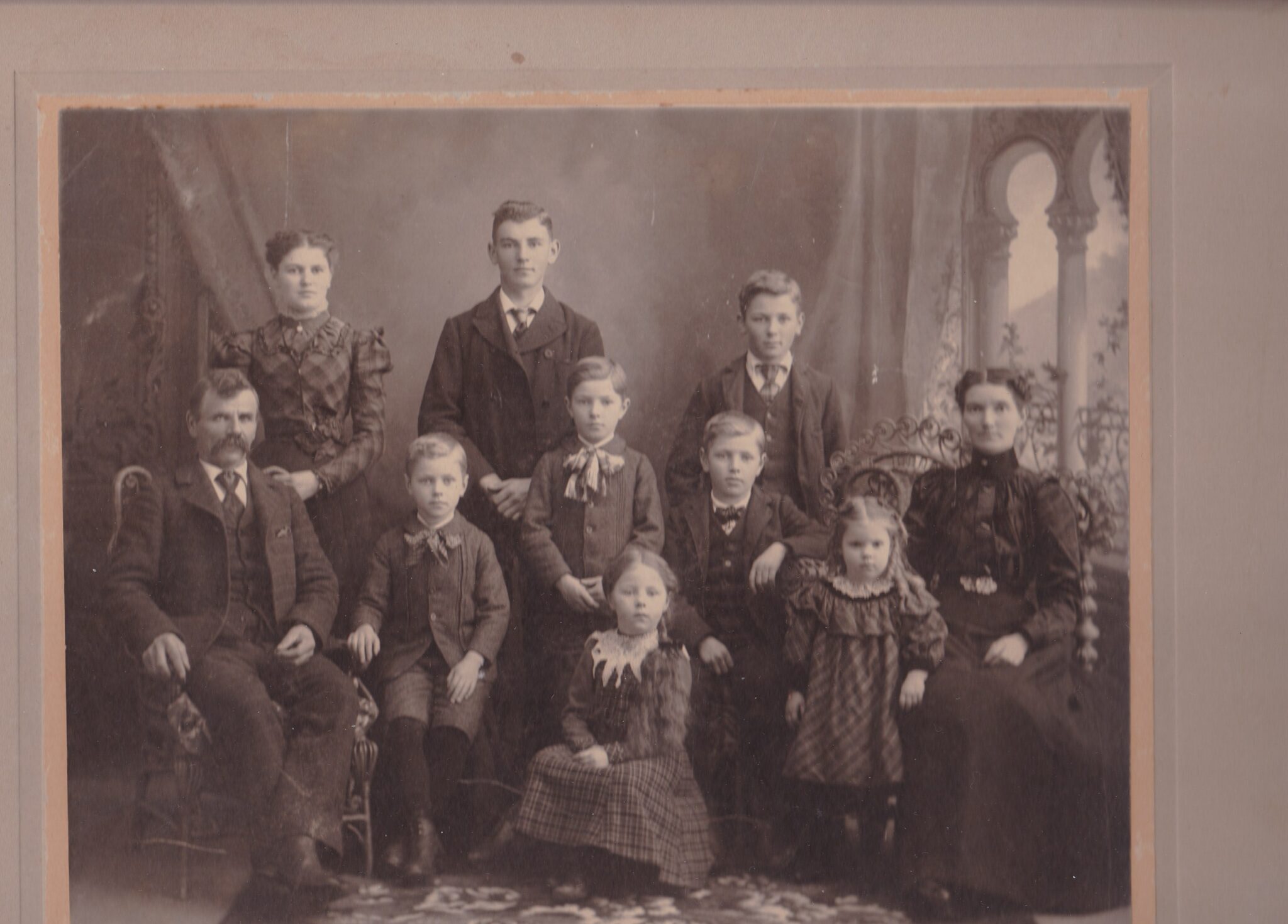
The Charles Wheeler Family circa 1900. Back: Carrie, Herb, Ernest. Centre: Charles, Cecil, Jesse, Lennie, Mary Ann; Front: Lena, Myrtle (Photo courtesy of Richard Anderson).
The Charles Wheeler Family, standing in birth order; youngest to oldest, L-R Myrtle, Lena, Cecil, Jesse, Lennie, Ernie, Herb, Carrie (Photo courtesy of Richard Anderson).
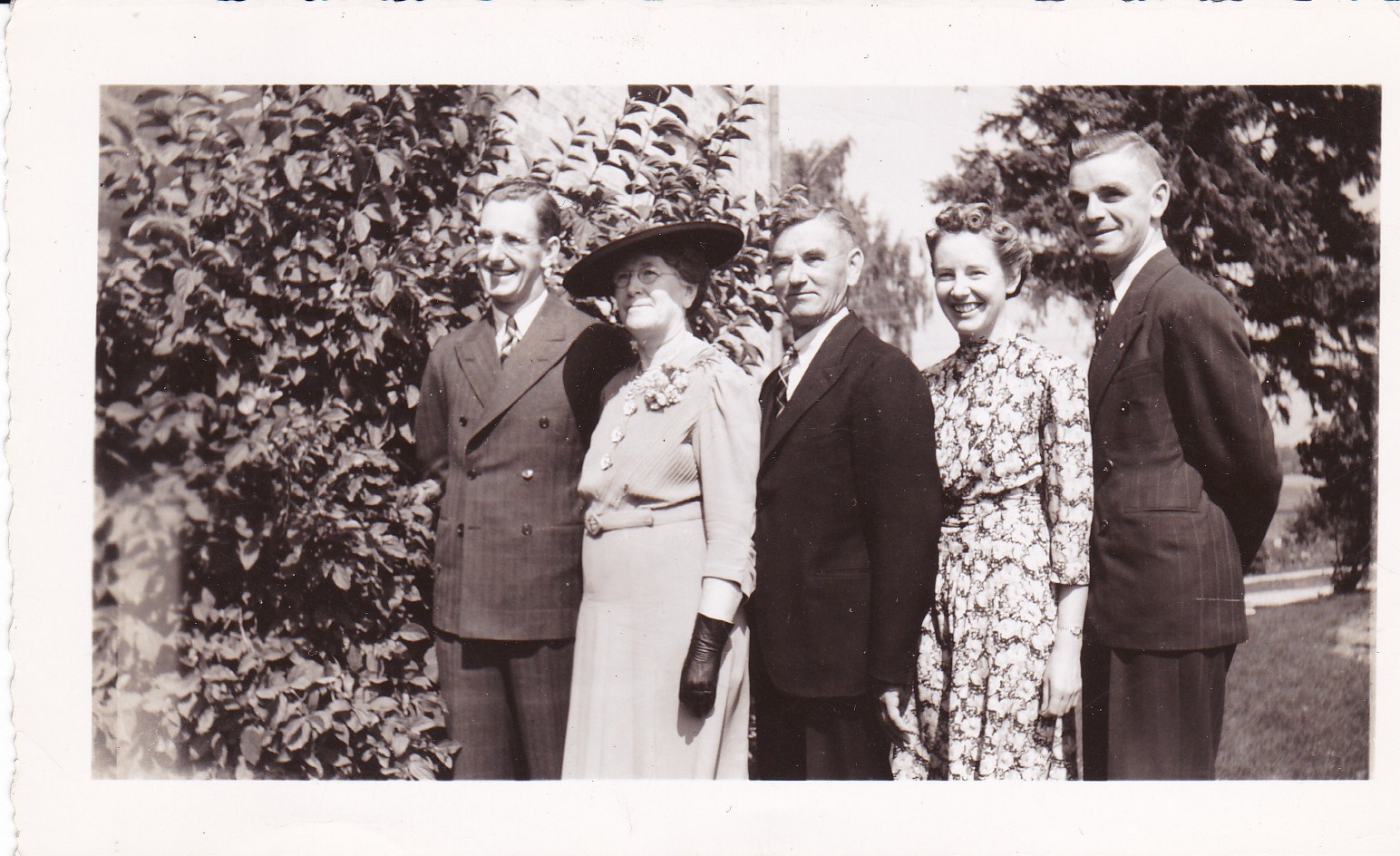
The Herb Wheeler Family: Goldie, Pearl, Herb, Velma and Ken (Photo courtesy of Richard Anderson).
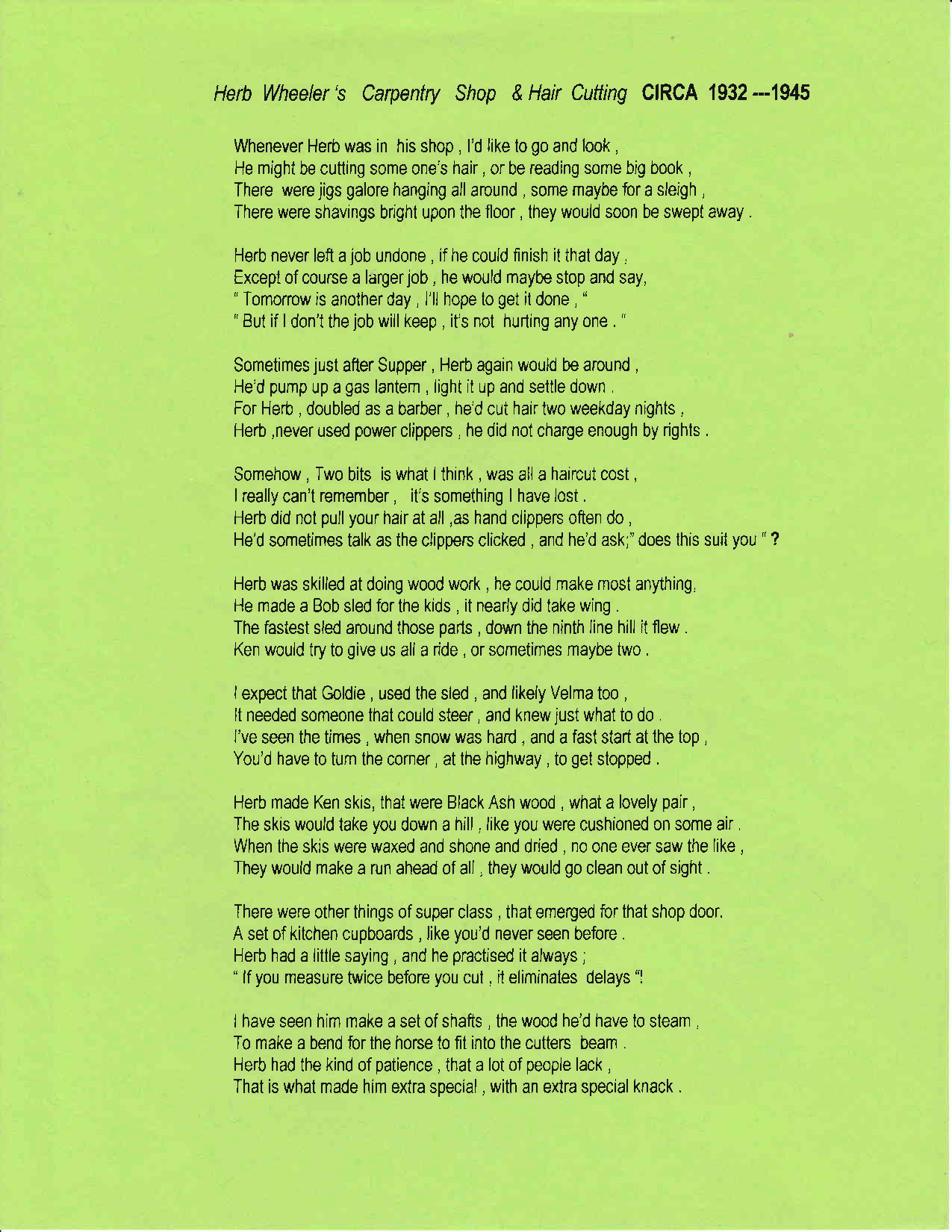
A poem written about Herbert Wheeler by a family member (Courtesy Richard Anderson; author unknown).
Former location of Herbert Wheeler's Shop, Belgrave, Ontario
Sarah as it turns out, is the daughter of Richard Anderson, great-nephew of Herbert Wheeler. Richard sent the following information about the history of the Charles Wheeler Family:
Charles Wheeler Sr. was born in Dorsetshire, England and came to Canada in 1846, locating in Tecumseh Township where he spent 18 years. In 1864 he moved with his family to Morris Township where he bought 300 acres which would be the N ½ of Lots 10, 11 and 12, Concession 5, more commonly known as the 4th Line. He married Caroline Lawrence and they raised a family of five sons, Charles, John and Lawrence of Morris Twp., William of Alma and Frank of Belgrave, and a daughter Mrs. Ann Hughes of Escanaba, Michigan.
This history is meant to briefly chronicle the family of Charles Wheeler, son of Charles Wheeler Senior.
Charles Wheeler married Mary Ann Wilkinson and they raised a family of five sons and three daughters.
Carrie married Andrew Taylor and they lived in Wingham. They didn’t have any family.
Herbert married Pearl Procter. They lived in Belgrave and had three of a family. Goldie, who married Winnie Lane and lived in London. Velma married Wilfred Pickell and lived in Vancouver. Ken married Mabel Coultes and farmed in East Wawanosh before retiring to Belgrave.
Ernest married Verna Elkington and lived mostly in Alberta and Saskatchewan. They had a family of two girls, Verna Wheeler who lived in Vancouver and Ila who lived in Alberta.
Lennie married Jennie Jordan and they lived most of their married life in Vancouver. They had a family of one boy, Howard, and one daughter, Gladys, both of B.C.
Jesse married Hazel Campbell and later Ethel Willock. They didn’t have any children.
Cecil married Edna Scandrett and Laura Robinson who both predeceased him. His first marriage to Edna Scandrett had a family of three girls. Nora who lived in London was married to Bernard Crellin. Ruth married Laurence Davis and lived in Brampton. Mary and her husband Bert Turner lived in Abbotsford B.C.
Lena married Nelson Higgins and they farmed in Morris Twp. They had a family of 8 children. Dorothy, Charles and Norman never married. Ferrol married Carman Farrier, Carrie married Tom Pletch, Ross married Wilma Johnston.
Myrtle married Jack Anderson and lived in Belgrave. They had a family of four children. Ross who married Barbara Michie and lived in Belgrave, Marie who died, aged two years. Lloyd married Eleanor Litt and lived in London. Donna who married Les Shaw and now resides in Goderich.
More interesting information about this branch of the Wheeler family…..
Charles Wheeler farmed on Lot 12 and after his death in 1913 his son Jesse took over the home farm. When Jesse married, his mother moved to Belgrave to the house now occupied by Wes and Annie Cook. Jesse continued to farm there until he retired to Belgrave.
Cecil farmed Lot 11 until he retired to Blyth.
Herbert had a wood working shop in Belgrave.
Ernest worked for the C.N.R. as an agent and dispatcher.
Carrie and her husband owned and operated the Queen’s Hotel in Wingham.
Lena and her husband farmed in Morris Tsp.
Myrtle and her husband lived in Belgrave and Jack operated a custom threshing operation.
Ironically, the only descendants of this family of Wheelers who continued farming in Morris were Lena’s son Ross Higgins and his son Bruce.
A note from David Pickell, Herbert Wheeler’s grandson
Hi! I’m Herb Wheeler’s grandson… When I knew my grandparents, Pearl and Herb, they lived in Belgrave. Their three children were Goldwyn (a school principal in London), A. Velma (my mother) and Kenneth, a farmer who lived and farmed a few minutes drive from Belgrave… Herb Wheeler was a carpenter and, as the name suggests, repaired farm equipment such as wooden wheeled carts etc. He was quiet, and had a subtle sense of humour us kids loved…” – David Pickell
The following poem written about Herbert Wheeler by a family member definitely gives a wonderful, lasting impression of just who Herbert was and his occupation as a talented woodworker, carpenter and barber. It would have been great to experience just what this writer did so long ago.
Herb Wheeler’s Carpentry Shop & Hair Cutting CIRCA 1932-1945
Whenever Herb was in his shop, I’d like to go and look,
He might be cutting some one’s hair, or be reading some big book,
There were jigs galore hanging all around, some maybe for a sleigh,
There were shavings bright upon the floor, they would soon be swept away.
Herb never left a job undone, if he could finish it that day,
Except of course a larger job, he would maybe stop and say,
“Tomorrow is another day, I’ll hope to get it done,”
“But if I don’t the job will keep, it’s not hurting any one. ”
Sometimes just after Supper, Herb again would be around,
He’d pump up a gas lantern, light it up and settle down.
For Herb, doubled as a barber, he’d cut hair two weekday nights,
Herb, never used power clippers, he did not charge enough by rights.
Somehow, Two bits is what I think, was all a haircut cost,
I really can’t remember, it’s something I have lost.
Herb did not pull your hair at all, as hand clippers often do,
He’d sometimes talk as the clippers clicked, and he’d ask, “does this suit you” ?
Herb was skilled at doing wood work, he could make most anything,
He made a Bob sled for the kids, it nearly did take wing
The fastest sled around those parts, down the ninth line hill it flew.
Ken would try to give us all a ride, or sometimes maybe two.
I expect that Goldie, used the sled, and likely Velma too,
It needed someone that could steer, and knew just what to do.
I’ve seen the times, when snow was hard, and a fast start at the top,
You’d have to turn the corner, at the highway, to get stopped.
Herb made Ken skis, that were Black Ash wood, what a lovely pair,
The skis would take you down a hill, like you were cushioned on some air.
When the skis were waxed and shone and dried, no one ever saw the like,
They would make a run ahead of all, they would go clean out of sight
There were other things of super class, that emerged for that shop door.
A set of kitchen cupboards, like you’d never seen before.
Herb had a little saying, and he practised it always
“If you measure twice before you cut, it eliminates delays”!
I have seen him make a set of shafts, the wood he’d have to steam
To make a bend for the horse to fit into the cutters beam.
Herb had the kind of patience, that a lot of people lack,
That is what made him extra special, with an extra special knack.
In conclusion
So far, the research has yielded no straight answers as to the gloves’ origin, but the search continues. While a pattern might give you a hint to the origin of a knitted item, you need to identify more such as the cast-on method, the type of ribbing, how the fringe was made, and how the strands (or floats) were carried across the back of the knitting. A full reproduction of Herbert’s gloves would help to answer the remaining questions.
In conclusion, there really isn’t a conclusion… But what I can say is that taking the time to explore knitting traditions and a local family’s history has been a fascinating, rewarding experience. I’m so grateful for Herbert’s relatives who have answered my questions and sent so many wonderful images to be shared here with everyone. They went to a lot of work to compile the info and family photographs and I can’t thank them enough for all their time and effort.
I’ve come to think that the original knitter may have incorporated features that he liked into these gloves, perhaps not following one certain pattern, but rather combining different elements into one. A full recreation of the gloves is planned for late fall 2021 and right now I’m testing a local wool I may be using for the reproduction. Stay tuned to the website for further updates as we move forward.
Huron Wristers Knitting Kit: If you’d like to knit a pair of Huron Wristers for yourself, please go to the FACTS website to purchase a kit.
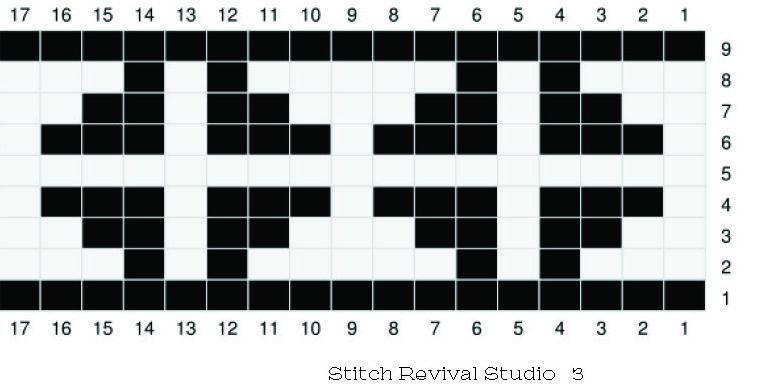
Alternatively, if you’d like to work with the colourwork pattern and stitch some history with your own yarn, here is a chart to get you started! The chart could probably also be used for cross-stitching or rughooking and I’d love to see how that would turn out.
Stitch Revival Studio on YouTube: Looking for a how-to on how to knit the gloves? I’ve just created a YouTube channel and will be uploading a series of Huron Wristers knitting how-to’s.
For me, this journey is all about the story in the stitches. It’s so wonderful to see people knitting local history and in doing so connecting with Herbert and his family. This brings history alive, this act of recreation, connecting us to Herbert, to our knitting traditions, and the wonderful textile collection at Huron County Museum and Historic Gaol. Imagine all the stories held within their textile collection, each item just waiting to share its history.
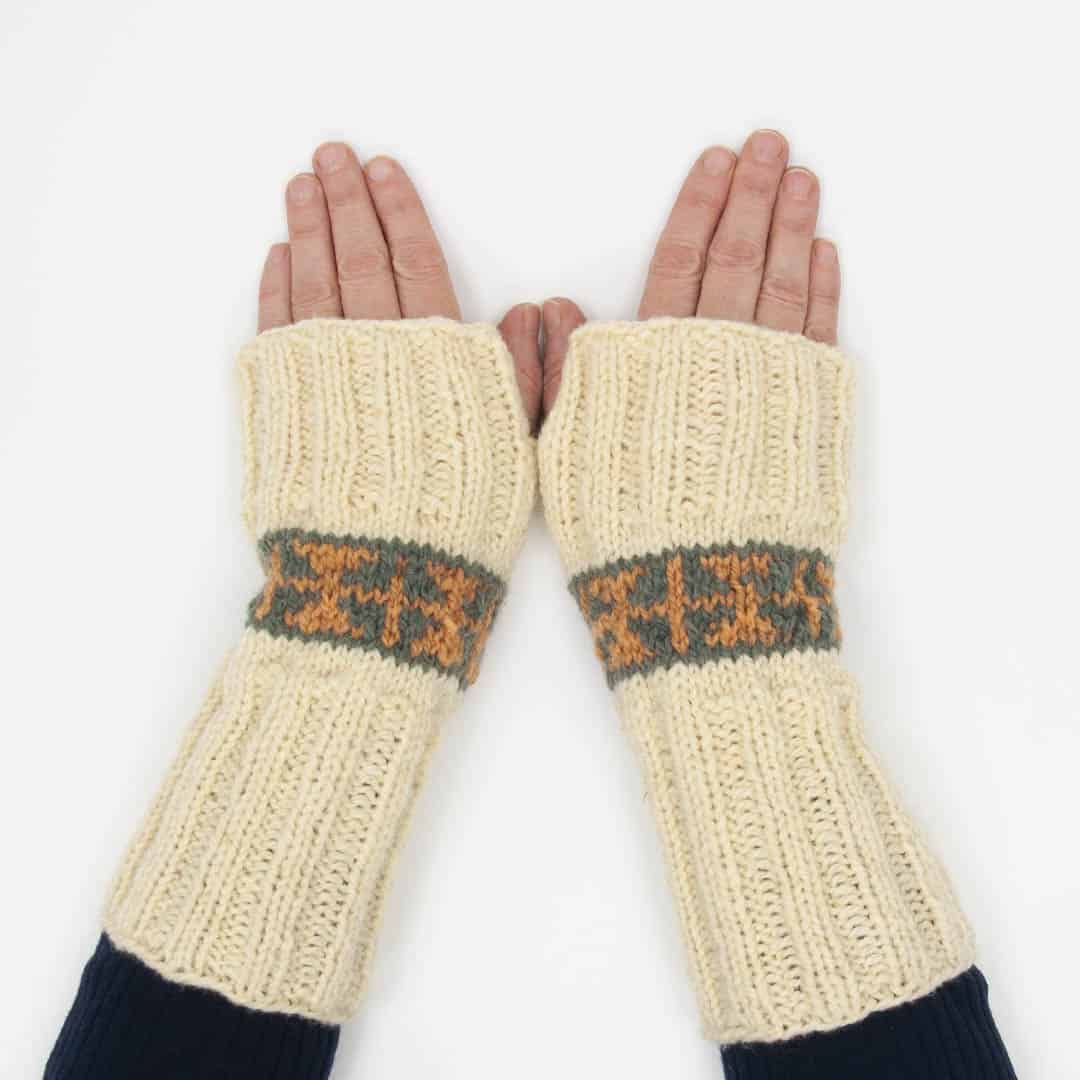
The Huron Wristers, inspired by the colourwork in Herbert’s knitted gloves.
The story of the creation of the Huron Wristers is a story of connections: the connection of past to present, of generation to generation.
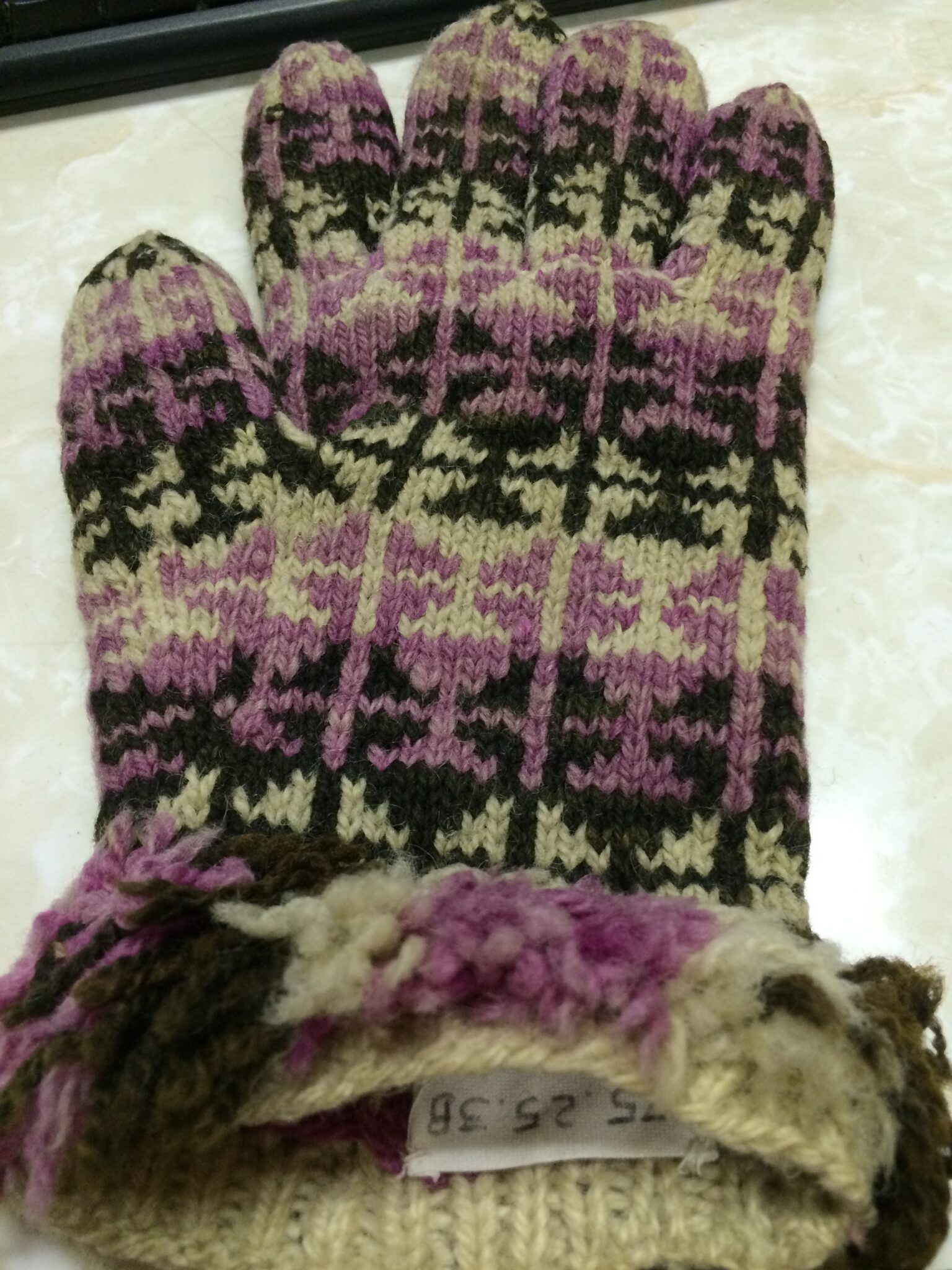
Back in 1972 Pearl Wheeler donated a pair of knitted gloves that once belonged to her husband Herbert to the Huron County Museum and Historic Gaol. The museum’s record notes that at the time the gloves were thought to date from 1870 and were knit by a man.
Herbert and Pearl lived in Belgrave, Ontario. Herbert had seven siblings, four brothers and three sisters. His parents were Charles Wheeler and Mary Ann Wilkinson. Herbert was a carpenter and apparently also the local barber. How long the gloves were in Herb’s possession no one knows.
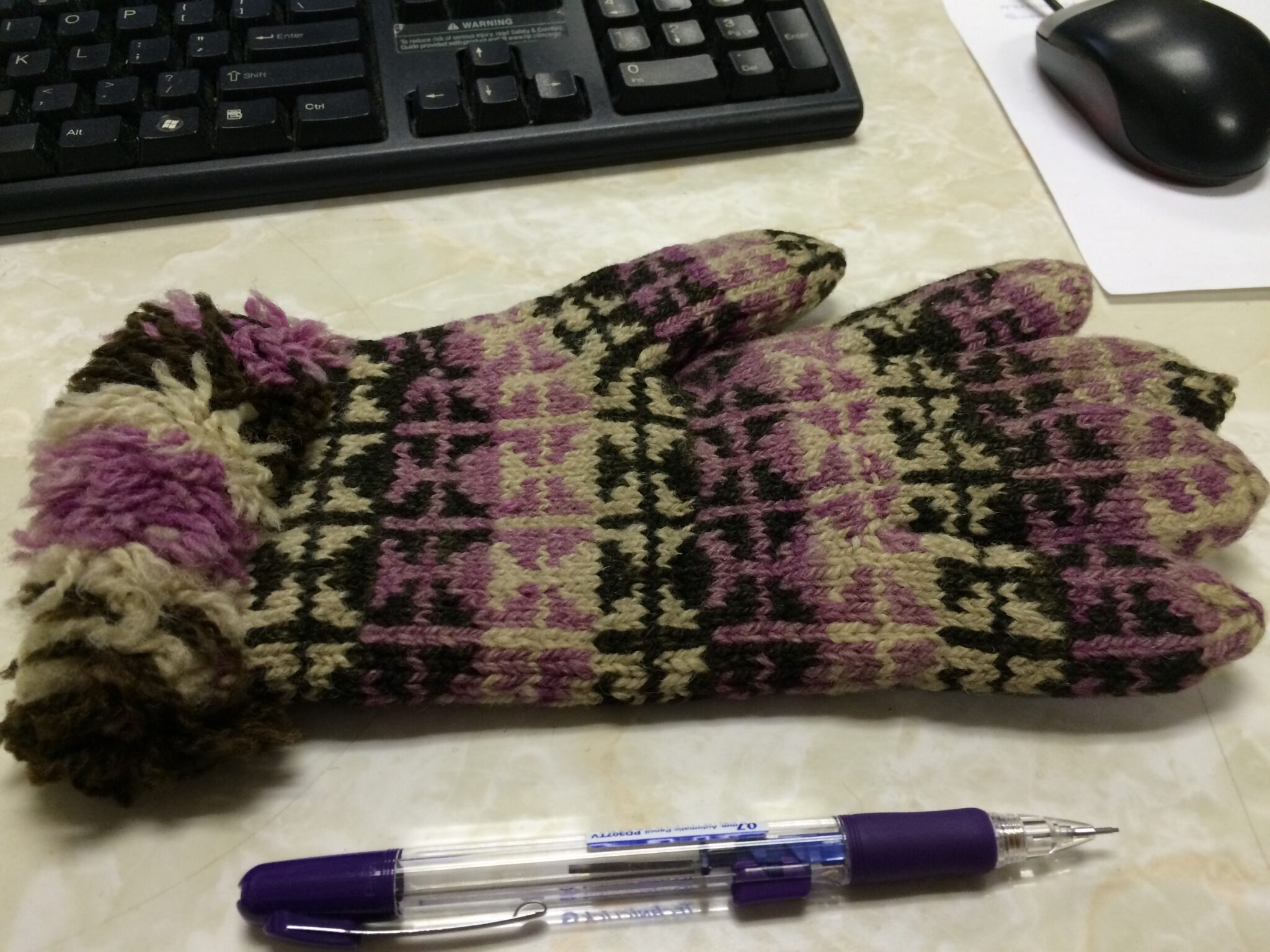
While in visiting the museum researching women’s headcoverings – I had an idea to recreate a head scarf one of my ancestors wore (that’s the lady on the upper left of the home page) – I happened upon an image of Herb’s gloves. There was something very intriguing about the gloves. First, the colours – the pink is very bold and the contrast between the pink and black is quite striking. Secondly, the colourwork pattern – it seems familiar, but yet different somehow. It looks Fair Isle inspired, but there’s something else there. And the fringe of the cuff, so interesting.
Who made these gloves? There’s no record of that. The gloves may have been knitted for Herbert by an older family member; or purchased at some point earlier on and then Herbert inherited them; or Herbert bought the gloves himself from someone; or given his trade, perhaps they were payment for some work he did. It was time to do research on the pattern and see what could be found.
The Colourwork Pattern of the Gloves
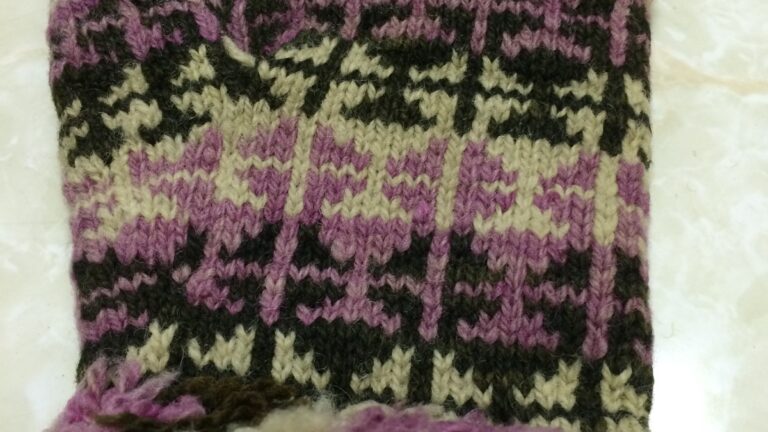
One of the pair of knitted gloves donated by Pearl Wheeler in 1972 and dated to approximately 1870 (Image used courtesy of the Huron County Museum and Historic Gaol).
The knitted glove once owned by Herbert Wheeler; the pencil gives an idea as to the size of the gloves (Image used courtesy of the Huron County Museum and Historic Gaol).
The Huron Wristers, inspired by the colourwork pattern of pair of gloves from the Huron County Museum.
The Old Hand Knitters of the Dales. A possible similarity to the museum's gloves?
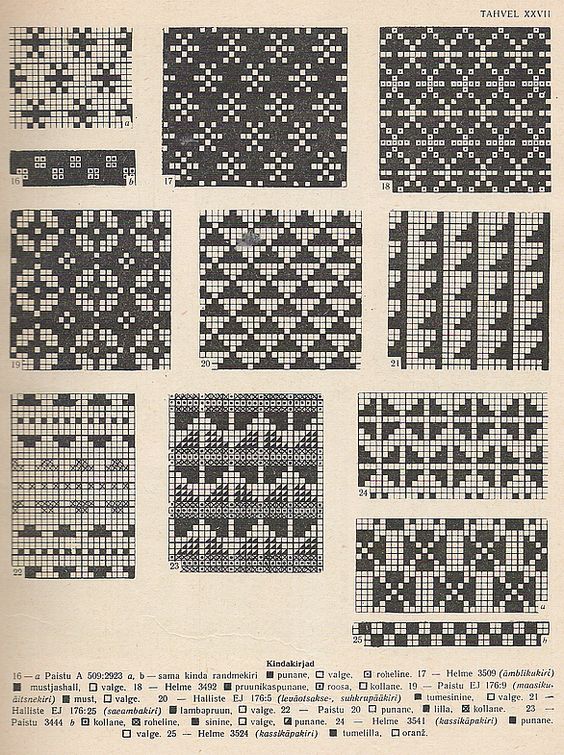
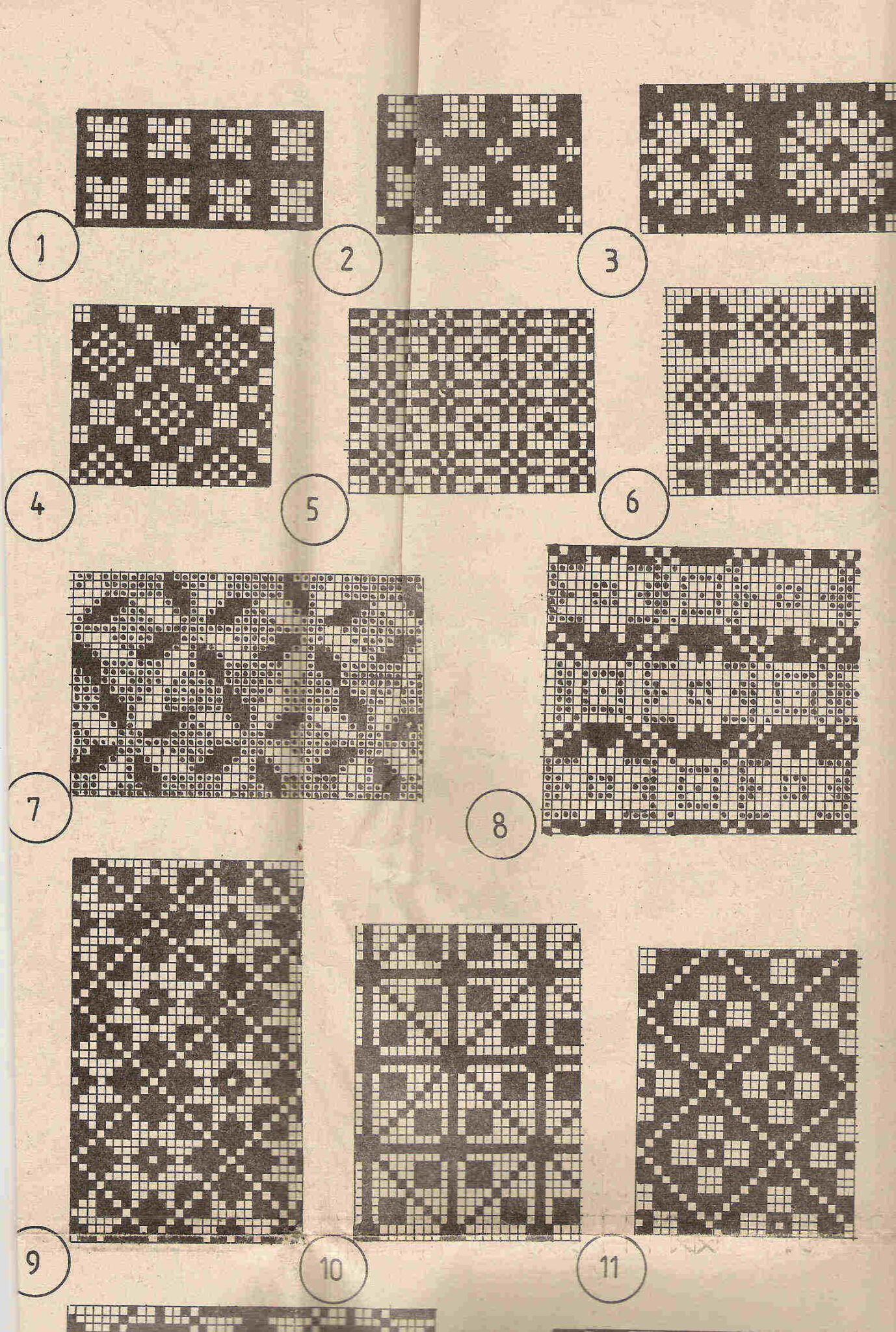
Estonian colourwork patterns. The chart third from the top is close to the colourwork pattern of the museum's gloves.
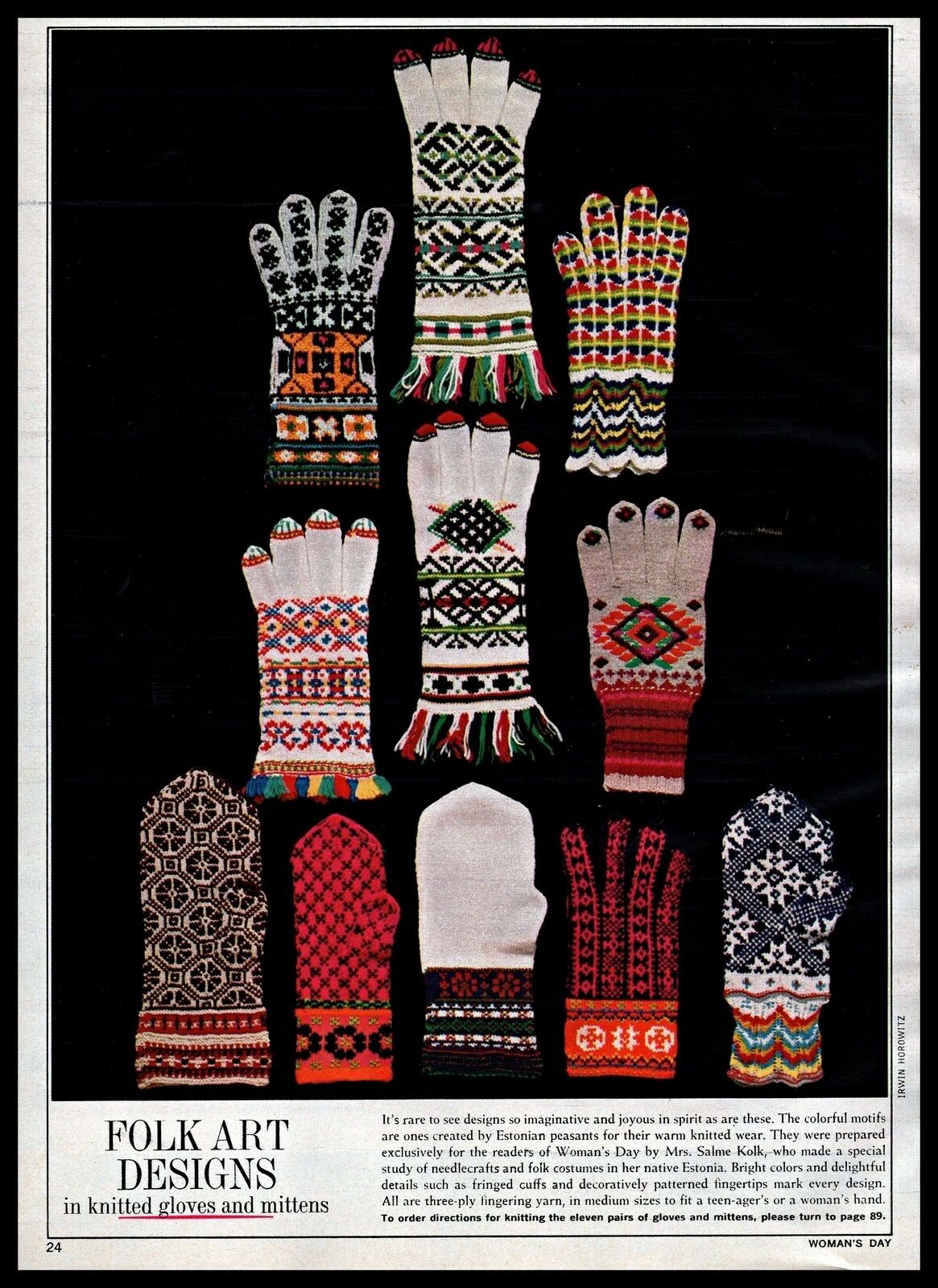
Traditional Estonian gloves and mittens showing the beautiful colourwork and fringed cuffs.
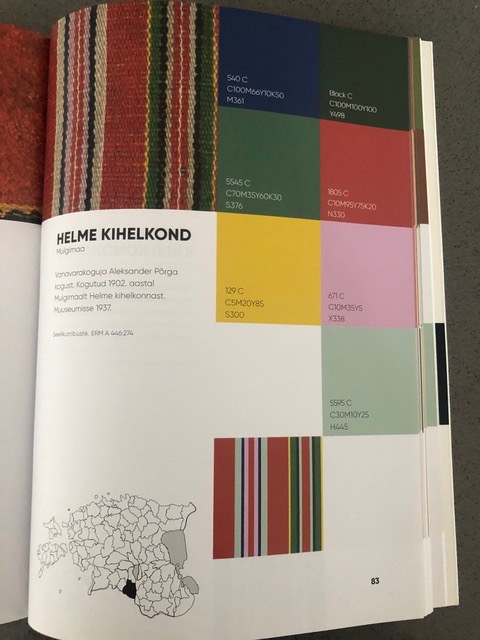
One of many traditional Estonian colour scheme. Herbert's gloves were knit with off-white, pink and black wool.
Estonian Mitten Pattern by Nancy Bush. The repeating motifs are almost a match for Herbert's gloves, but for the fact they are offset, nested within each other, not point to point.
More Estonian colourwork patterns.
Estonian Mitten Pattern. Once again, the repeating motifs are almost a match for Herbert's gloves, but for the fact they are offset. Note the position of the thumb; Herbert's gloves feature the thumb at the side not the palm.
Herbert’s gloves were knit in the round using the stranded colourwork technique, working two colours of yarn in the same row, carrying the unused yarn across the inside of the work. The 8-stitch motif repeating pattern is similar to both the Shetland Fair Isle knitting pattern, ‘Little Flowers’ as well as an Estonian pattern called, ‘Cat’s Paw’.
The gloves feature a knitted fringe on a short ribbed cuff. Fringing has been used on both Latvian mittens and Estonian gloves, historical and modern versions and not so much in the Fair Isle tradition. The fringe appears to have been done using a loop technique which is done during the construction of the glove. The colourwork may seem close to the Sanquhar tradition, but it’s not a match for the following reasons according to knitters on the Knitting History Forum:
There are quite a few designs associated with Sanquhar. Possibly the most well known ones are based on 11 by 11 stitch squares. The squares have strong outlines with alternating patterns within the squares. Herb’s gloves therefore do not fulfill these criteria.
Some Sanquhar gloves also have an interesting finger construction with little triangular gussets in the finger spaces and triangular finger tips. Also, all Sanquhar have a shaped thumb placed on the palm side rather than on the side of the hand as here.
Finally, the stitch count, wool and colour are not really in the Sanquhar tradition. Gloves tend to be monochromatic. Wool used is finer, stitch count for the cuff around 80 stitches and modern needle size of around 2mm used.
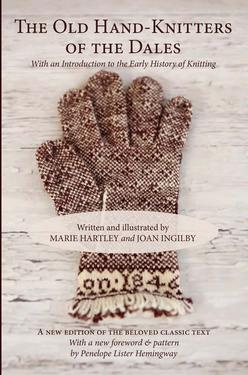
The Old Hand-Knitters of the Dales, a book about the knitting traditions of the Dales of England. The glove, with a fringed cuff, is similar in some ways to Herbert’s gloves in the Huron County Museum.
The Knitting History Forum was invaluble as it connected me with Angharad Thomas, researcher, designer and knitter. Angharad wrote, “The only pattern I could find similar to that used in these gloves was a 4 stitch x 4 row triangle in a Shetland pattern book … but there’s a limit to what can be knitted on a given number of sts in whatever colours are to hand. That’s how I think these patterns came about rather than from one tradition or another. Fringes are now associated with Latvia but there are gloves from the north of England with a fringe…” Angharad then suggested I reach out to Shirley Scott, Canadian knitting designer.
Shirley Scott, knitting designer and author
Shirley Scott, knitting designer and author, immediately suggested the similarity to Estonian mitten patterns and sent a few images of pattern motifs. She then pointed me in the direction of Nancy Bush, an Estonian knitting expert. Shirley also cautioned that there may be no clear and definitive answer as to the pattern name and origins.
Don’t be surprised if the pattern has no real name. Newfoundland patterns have never had names, for example. We made ours up, as explained in our books. It’s also hard to pinpoint the origins of patterns these days because North America has had so many waves of immigration and so much pattern sharing.
– Shirley A. Scott, knitting designer, author of Canada Knits; Saltwater Mittens; Saltwater Classics
Nancy Bush, Estonian knitting expert
Nancy Bush a knitting writer, designer and authority on Estonian knitting, wrote:
“I have found a pattern close to the one on your mittens from both Paistu and Helme parishes in Estonia (these are southwest). The difference is that the diamond with cross shapes are offset, as is the example of Sander’s Mittens in Folk Knitting in Estonia. There is another pattern that is like the ones from Helme and Paistu in a pattern book from the Rannarootsi Museum in Haapsalu. This museum tells the story of Swedish/Estonian people who lived in Estonian territory, mostly until the 2nd WW. I don’t know the story of these exact mittens, just that the pattern is close.
The fact that the diamond with cross shapes are stacked instead of offset makes me think they were not looking at any of the patterns I have mentioned above, or mittens made like them…
All that being said… this is a very simple pattern, easy to create with knit stitches and could have originated almost anywhere… it is very possible these mittens were made by someone who was remembering a pattern they knew as a child, for instance, and reproduced it as best they could, with the yarn they had…”
So, which was it, Estonian or Fair Isle? It was time to research the Wheeler family and Herbert. Where did their family originate? Was there a family tie to either Estonia or the British Isles? When an instagram post by Best Dishes, a Goderich business owned by Sarah Anderson, appeared in my feed one day identifying the wristers pattern as based on a family heirloom, chance had dropped the opportunity in my lap. It was time to connect. A couple messages back and forth and the story unfolded…
Huron Wristers Knitting Kit: If you’d like to knit a pair of Huron Wristers for yourself, please go to the FACTS website to purchase a kit.
Alternatively, if you’d like to work with the colourwork pattern and stitch some history with your own yarn, here is a chart to get you started! The chart could probably also be used for cross-stitching or rughooking and I’d love to see how that would turn out.
Stitch Revival Studio on YouTube: Looking for a how-to on how to knit the gloves? I’ve just created a YouTube channel and will be uploading a series of Huron Wristers knitting how-to’s.
I enjoy reading about and researching historic textiles. For me, these vintage textiles provide a invaluable, tangible link to our past. And as I work at reproducing old knitting patterns and recreating vintage knitted items, I find that the local museums hold a wealth of reference material in their textile collections, providing wonderful period pieces to help with pattern identification and reproduction.
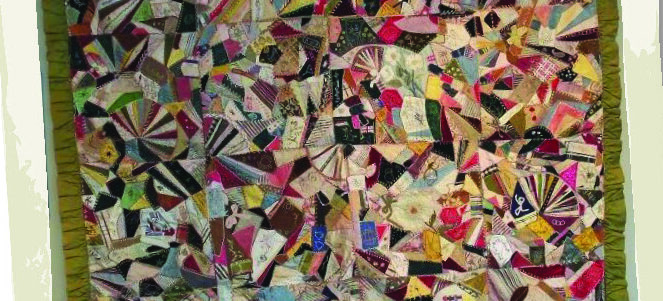
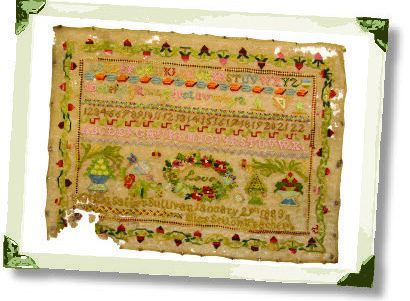
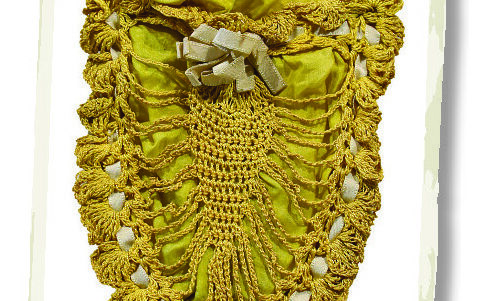
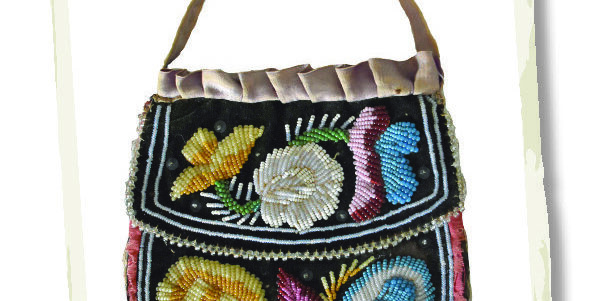
Recently I enjoyed the privilege of seeing (virtually, of course) textile items from the collection of the Bruce County Museum and Cultural Centre. I saw many wonderful, beautiful items, some knit, others crocheted, some embroidered, others sewn and so on. From knitted coverlets and clothing, cross stitch samplers, to crochet bedspreads and hair receivers — yes, hair receivers — to beaded purses and to knitting tools, the collection is extensive and varied.
The Grey-Bruce Boomers have included my article, A Link to Our Past – Exploring Historic Textiles in our Local Museums in their Winter 2020-2021 edition. The article features a number of the lovely textile items from the Bruce County Museum.
My personal favourites are always the ‘counterpanes’, the knitted and crocheted white bed coverlets and blankets that were once so popular in the late 1800s and early 1900s. Have a look through the images accompanying the article.
If you’d like to have a read, please click here! The story is on page 22. Visit www.greybruceboomers.com to read the magazines in its entirety and sign up to receive updates when new issues are available.
Whether you’re a needle worker or not, there’s much to see and enjoy in the textile collection of the Bruce County Museum. There are such interesting stories connected to many of the items; it’s a truly fascinating experience. If you would like to know more about the Bruce County Museum and its textile collection, visit www.brucemuseum.ca or call Laura Leonard at (519) 797-2080, or email museum@brucecounty.on.ca. The museum is located at 33 Victoria St. N., Southampton. Given the COVID-19 pandemic, virtual visits are a necessity at this time. Please go to https://brucemuseum.pastperfectonline.com/ to have a look through their online collection.